

Did you know mortgage rates can rise even when the Federal Reserve leaves its rate unchanged?
That is the question many Longview-area buyers are asking as the Federal Reserve prepares for its October 27–28 meeting. If you are buying a home in Longview, Gilmer, Jefferson, or a nearby East Texas community, you may be wondering whether to lock your mortgage rate now or wait to see what happens after October 28.
Let’s walk through the decision in plain English.
Where Mortgage Rates Stand Right Now
As of October 9, 2026, Freddie Mac’s weekly survey showed the average 30-year fixed mortgage rate at 7.40% for the week ending October 8.
That is:
- Up from 7.28% the previous week
- The seventh consecutive weekly increase
- Up from 6.30% one year ago
- The highest level in nearly three years
Remember, Freddie Mac’s figure is a national benchmark, not a guaranteed rate for your specific loan. Your credit, down payment, loan type, property, points, and lender pricing all matter.
Lenders have also widened their margins recently. That means the rate you are personally quoted may matter more than the headline rate you see online. Comparing lenders and asking for a complete Loan Estimate can make a meaningful difference.
You can review current rate trends through Freddie Mac’s Primary Mortgage Market Survey.
Why the October Fed Meeting Matters, and Why It May Not Lower Mortgage Rates
Markets currently place roughly 85% odds on the Fed holding rates steady at the October 27–28 meeting. At the same time, the Fed’s own projections still leave room for one more increase before the end of the year.
That sounds important for mortgage rates, but here is the part that can be confusing:
Mortgage rates do not directly follow the Federal Reserve’s short-term Fed funds rate.
The Fed funds rate influences short-term borrowing, such as certain credit cards and other short-term loans. Mortgage rates are influenced more heavily by the 10-year U.S. Treasury, mortgage-backed securities, inflation expectations, investor demand, and lender margins.
Think of it this way:
- The Fed announces a policy decision.
- Investors interpret what that decision means for inflation and the economy.
- Treasury yields and mortgage-backed securities react.
- Lenders adjust mortgage pricing.
Sometimes that chain results in lower mortgage rates. Sometimes rates barely move. And sometimes mortgage rates rise after a Fed hold because investors expected a different message.
Analysts currently expect mortgage rates to remain in the 7% range through October, with some possible easing by year-end. But “possible” is not the same as guaranteed, and no one can know what rates will do on a specific day.
The Federal Reserve’s official October 2026 calendar lists the meeting for October 27–28, with the statement and press conference scheduled for October 28.
The takeaway: Do not treat October 28 as a deadline that guarantees lower mortgage rates.
Should You Lock or Float Your Rate?
A rate lock means your lender agrees to hold a particular interest rate for a specific period while your loan moves toward closing. Floating means you allow your rate to move with the market.
Locking may make sense when:
- You have an accepted purchase contract
- You expect to close within 30–45 days
- Your monthly payment already fits your family’s budget
- A rate increase would make the home uncomfortable or unaffordable
- You would rather have certainty than gamble on a market event
With rates rising for seven straight weeks, locking a competitive quote can be a reasonable way to protect your purchase.
Floating may make sense when:
- Your closing is more than 45–60 days away
- You have flexibility in your closing date
- You understand that rates could rise
- Your lender gives you clear written terms for a float-down or re-lock
- You can handle a higher payment if the market moves against you
Floating is not automatically wrong. It simply means you are accepting more risk in exchange for the possibility of getting a better rate later.
The cost of guessing wrong can be significant. On a loan of about $243,200, even a half-percentage-point increase can add roughly $80 or more to the monthly principal-and-interest payment, depending on the exact rates and terms.
So the best decision is not about predicting the market perfectly. It is about choosing the amount of risk your household can comfortably handle.
Understanding 30-, 45-, and 60-Day Rate Locks
Your lock period should match your expected closing timeline.
A 30-day lock
A 30-day lock may offer better pricing than a longer lock, but it leaves less room for delays. It may work well when your appraisal, underwriting, title work, and closing schedule are already moving smoothly.
A 45-day lock
A 45-day lock gives you more breathing room. This is often a practical choice for a typical purchase transaction, especially when the seller, title company, or appraisal timeline may require extra time.
A 60-day lock
A 60-day lock can make sense when you are purchasing new construction, dealing with a complicated transaction, or expecting a longer closing period. The tradeoff is that a longer lock often costs more through a higher rate, additional points, or less favorable pricing.
Ask your lender:
- What is the exact lock expiration date?
- What happens if closing is delayed?
- How much would an extension cost?
- Does the lock cover weekends and holidays?
- Is a float-down included?
A short lock that expires before you close may not be a bargain if you later need to pay an extension fee.
What If Rates Fall After You Lock?
This is one of the most common concerns buyers have.
Some lenders offer a float-down option, which may allow you to take advantage of a lower rate after locking. However, the terms vary widely.
A float-down may include:
- A minimum rate improvement, often around 0.25 percentage points
- A specific time window when you can use it
- A one-time exercise limit
- An added fee or pricing adjustment
- Rules that vary by loan type
For example, if you lock at 7.40%, a lender may require rates to improve by at least 0.25% before allowing a float-down. You may also need to request it several days before closing.
A float-down is not automatic. Ask for the terms in writing before you lock. The Consumer Financial Protection Bureau’s explanation of rate locks is also a helpful starting point.
The Payment Difference on a $304,000 Longview Home
The median sold price in the Longview area is holding around $304,000, according to September 2026 market information. Longview also has roughly 610 active listings, with homes sitting around 68–71 days on the market. That gives buyers meaningful room to negotiate.
Let’s look at the rate difference using a simple example:
- Home price: $304,000
- Down payment: 20%
- Estimated loan amount: $243,200
- Loan term: 30-year fixed
- Taxes, homeowners insurance, and mortgage insurance: excluded
| Interest rate | Estimated monthly principal and interest |
|---|---|
| 7.40% | About $1,685 |
| 7.00% | About $1,618 |
The difference is approximately $67 per month, or about $804 per year.
That may not sound enormous by itself, but your complete payment also includes property taxes, homeowners insurance, and possibly mortgage insurance. For many families, $67-or a larger change caused by a future rate increase, can affect the home price that feels comfortable.
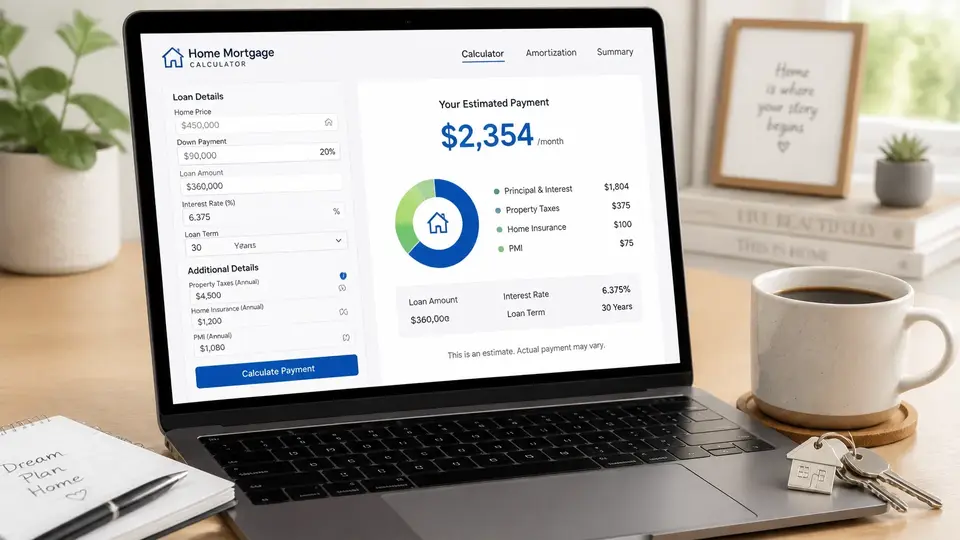
Use Greenlight’s mortgage calculator to look at your own numbers.
Three Tools That Can Help More Than Guessing
You do not always have to solve affordability with the interest rate alone.
1. Seller credits
In today’s Longview buyer’s market, you may be able to negotiate for the seller to contribute toward eligible closing costs, prepaid expenses, discount points, or other approved costs.
The amount allowed depends on your loan type, down payment, occupancy, and program rules. Your lender can help you determine whether asking for a credit makes sense.
2. Temporary buydowns
A temporary buydown can reduce your payment during the first year or two of the loan. A common structure reduces the rate more during the first year, then less during the second year, before returning to the full note rate.
This may be helpful if:
- You expect your income to rise
- You are receiving seller assistance
- You need short-term payment relief
- You want to buy now without stretching your long-term budget
A temporary buydown does not permanently reduce your mortgage rate, so make sure you are comfortable with the payment after the introductory period ends.
3. Greenlight’s “3rd Option”
At Greenlight, we often talk about a 3rd Option for families who feel stuck between two choices:
- Wait indefinitely for rates to fall, or
- Buy now with a payment that feels too high.
The third path is to look at the entire loan structure, not just the headline rate. That may include comparing loan programs, negotiating seller credits, considering a temporary buydown, adjusting the down payment, or choosing a home price that better fits your monthly budget.
This is not a promise that rates will fall. It is a practical, personalized way to find a responsible path forward instead of relying on one uncertain market prediction.
Greenlight offers a wide range of loan options, including conventional, FHA, VA, USDA, jumbo, and refinancing solutions.
How Pre-Approval Helps You Lock Quickly
A strong pre-approval does more than tell you a price range. It helps you understand your complete monthly payment and prepares your loan file before you find the right home.
Working with my team and me, we can help you:
- Review income, assets, credit, and debts
- Set a payment target, not just a maximum approval amount
- Compare loan programs
- Estimate taxes, insurance, and mortgage insurance
- Discuss seller credits and buydown options
- Compare actual lender pricing
- Move quickly when you have an accepted offer
A pre-approval is not the same as a rate lock. Your rate is typically locked after you have a property and a closing timeline. But being prepared means you are not starting from scratch when the moment comes.
You can apply online or call Greenlight Mortgage at 903-331-0892 to talk through your situation.
So, Should You Lock Before October 28?
If you have a contract and expect to close within the next 30–45 days, locking a competitive rate now is generally more defensible than waiting unprotected for the Fed meeting.
If your purchase is farther away, floating may be reasonable, but only if you understand the downside and have a clear plan for what happens if rates rise.
Either way:
- Compare more than the headline rate
- Review points, lender credits, and APR
- Confirm your lock period covers closing
- Ask about extension costs
- Ask whether a float-down is available
- Base your decision on the payment your family can comfortably afford
The Longview market is giving buyers more choices and negotiating power right now. You do not have to wait for perfect rates to make a smart purchase, and you do not have to accept a payment that makes you uncomfortable.
At Greenlight Mortgage, we believe mortgage guidance should feel personal, clear, and family-focused. We will help you compare your options, stay informed, and move forward with a plan that fits your goals. And after closing, our relationship does not end. We even offer qualifying clients use of a free moving truck to help make the move a little easier.

Market data and payment examples are for educational purposes only. Mortgage rates, program availability, qualification requirements, taxes, insurance, and closing costs vary. This is not a commitment to lend. All loans are subject to credit approval and applicable guidelines.
Have questions about your own situation? Call Kenneth Travis's team at 903-331-0892 or start your pre-approval.
This is not a commitment to lend. All loans subject to credit approval. Guidelines subject to change without prior notice. Rates, programs and figures mentioned in this article reflect the date it was published.